
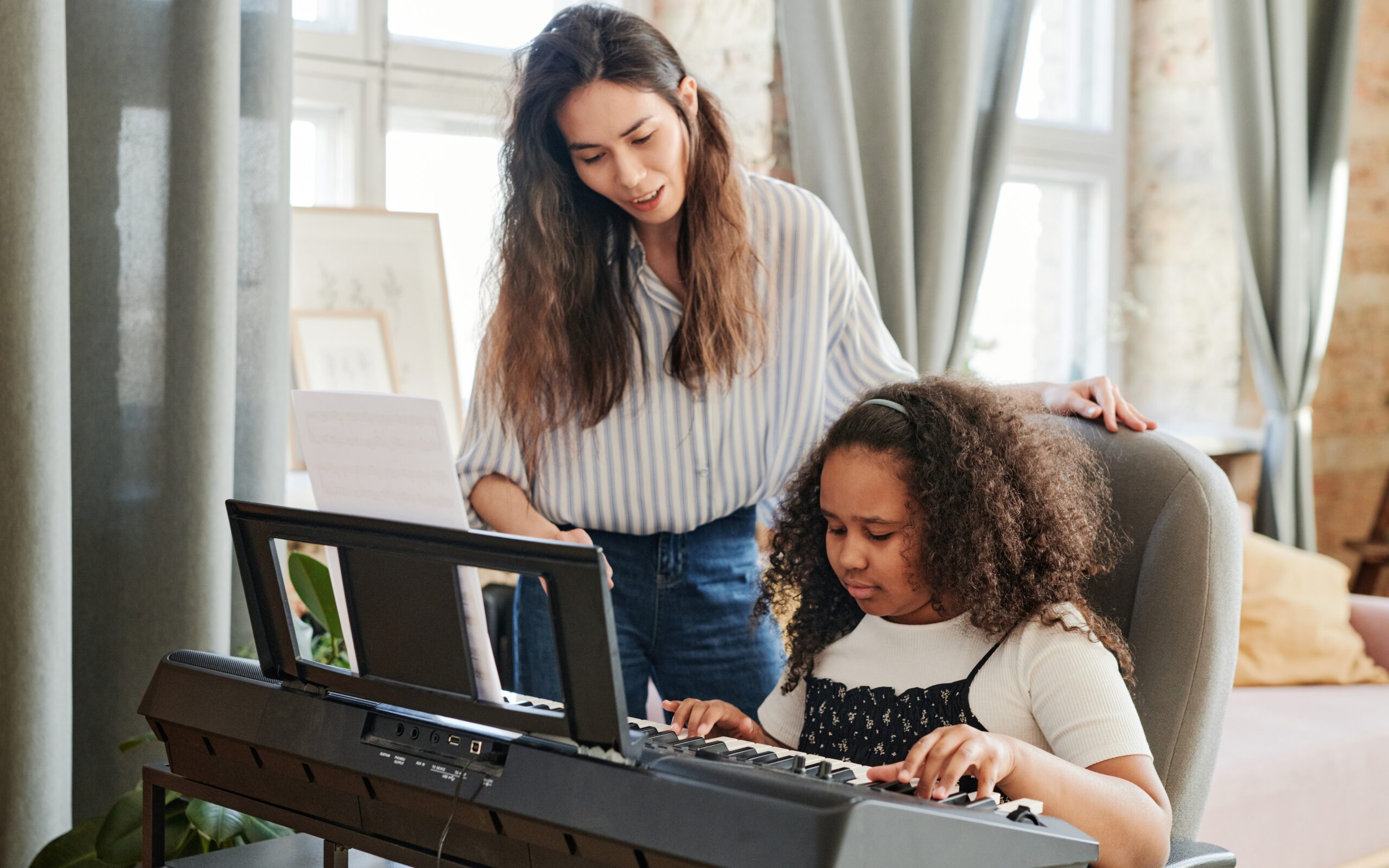
5 Free ways to learn piano at home: A step-by-step guide for beginners.
Ever sat down at a piano and felt that overwhelming urge to play
something-anything-but had no clue where to start? You’re not alone. About
21 million Americans want to learn piano but never take the first step
because it seems too complicated without a teacher.
Here’s the truth, you absolutely can learn piano at home, without
expensive lessons or complicated methods.
This step-by-step guide to learning piano at home will walk you through
everything from choosing your first keyboard to playing your favorite
songs, all on your own schedule and without leaving your living room.
The best part? You don’t need natural talent or previous musical
experience-just a willingness to practice consistently and the right
approach. But before we dive into the practical steps, there’s something
crucial about how your brain learns music that most beginners completely
miss….
Getting Started: Essential Piano Equipment
A. Choosing the Right Piano or Keyboard for Beginners
Look, piano shopping can be overwhelming. Here’s the deal, as a beginner,
you don’t need a $5000 grand piano taking up half your living room.
For most beginners, a digital keyboard with 88 keys is perfect. Why?
They’re affordable (starting around $200-400), don’t need tuning, and many
come with headphone jacks so you can practice at 2 AM without your
roommate plotting your demise.
The absolute must-haves in a beginner keyboard:
- 88 keys (full-sized)
- Weighted or semi-weighted keys that feel like a real piano
- Touch sensitivity (plays louder when you press harder)
- Built-in speakers
- Sustain pedal capability
Brands like Yamaha, Casio, and Roland make solid beginner models. The
Yamaha P-45 or Casio Priva PX-1007? Total crowd favorites for good reason.
If space is tight, a 61-key keyboard works too, but you’ll eventually
outgrow it.
B. Setting Up Your Practice Space
Your practice environment makes or breaks your piano journey. Trust me.
Find a spot with minimal distractions. That corner by the TV where
everyone walks through? Bad idea.
Good lighting is non-negotiable – you need to see those sheet music notes
clearly.
Make sure your setup includes:
-
A proper bench at the right height (elbows should be slightly below the
keyboard) - Enough room for your elbows to move freely
- Good posture support (your back will thank you)
- Minimal echo (carpet or rugs help)
The bench height matters way more than you think. When seated, your
forearms should be parallel to the floor. Too high or low, and you’re
asking for wrist pain.
C. Essential Accessories Worth Investing In
Skip the fancy stuff for now, but don’t cheap out on these essentials:
-
Adjustable bench – The folding X-style benches are fine to start, but an
adjustable one will save your back. -
Sustain pedal – Even basic keyboards need one. It’s that magical thing
that makes notes ring out. -
Music stand – Either built into your keyboard or separate. Balancing
sheet music on your lap? Nightmare. -
Metronome – Your new best friend/worst enemy. It keeps you honest with
timing. -
Headphones – Good ones. Not the earbuds from your phone. You need to
hear all the nuances in your playing.
Bonus: a recording device (even your phone) to listen back to your
practice. Sometimes what you think you played and what you actually played
are completely different things.
D. Digital Learning Tools and Apps
The internet has revolutionized piano learning. You’re not stuck with just
dusty method books anymore.
Some game-changers:
-
Piano learning apps: Simply Piano by JoyTunes, Flowkey, and Playground Sessions walk
you through lessons step by step. -
YouTube tutorials: Channels like Piano With Jonny and PianoTV offer
free lessons that break down songs and techniques. -
Virtual sheet music: Apps like Musescore give you access to thousands of
pieces and let you adjust tempo as needed. -
Practice tracking tools: Apps like Modacity help you organize practice
sessions and track progress. -
MIDI connectivity: Most digital pianos can connect to your computer,
opening up a world of learning software.
The coolest part? Many apps provide instant feedback on your playing. They
literally tell you when you hit wrong notes. No more wondering if you’re
messing up that Mozart piece!
Understanding Piano Fundamentals
Reading Basic Music Notation
Ever stared at sheet music and felt completely lost? You’re not alone.
Music notation can look like hieroglyphics when you first start, but it’s
actually a straightforward language once you get the basics down.
Sheet music has five lines called a staff. The notes sit either on the
lines or in the spaces between them. For piano, you’ll deal with two
staffs connected by a brace – the upper staff (treble clef) for your right
hand and lower staff (bass clef) for your left.
Notes have different shapes that tell you how long to play them:
- Whole notes: empty circles (hold for 4 beats)
- Half notes: empty circles with stems (2 beats)
- Quarter notes: filled circles with stems (1 beat)
- Eighth notes: filled circles with stems and flags (1/2 beat)
Don’t try to memorize everything at once. Start with middle C and work
outward.
Proper Hand Position and Posture
Your body is your first instrument. Sit at the middle of the keyboard with
your back straight but not stiff. Your feet should be flat on the floor,
and your bench height should position your forearms parallel to the floor.
For hand position, imagine holding a small apple in each hand. Your
fingers should be gently curved, with fingertips touching the keys. Keep
your wrists level with your hands- not too high or too low.
Common mistakes beginners make:
- Tense shoulders (keep them relaxed and down)
- Flat fingers (maintain that gentle curve)
- Collapsed wrists (think of a straight line from elbow to knuckles)
When playing, use the pads of your fingertips, not the very tips or the
flats of your fingers. Your thumbs should rest on their sides.
Finger Numbering System
Piano uses a simple numbering system for fingers that makes learning and
reading music much easier:
| Hand | Finger | Number |
|---|---|---|
| Right Hand | Thumb | 1 |
| Right Hand | Index | 2 |
| Right Hand | Middle | 3 |
| Right Hand | Ring | 4 |
| Right Hand | Pinky | 5 |
| Left Hand | Thumb | 1 |
| Left Hand | Index | 2 |
| Left Hand | Middle | 3 |
| Left Hand | Ring | 4 |
| Left Hand | Pinky | 5 |
Developing Your Practice Routine
Creating a Sustainable Schedule
Piano practice isn’t about marathon sessions once a week. It’s about
consistency, plain and simple.
Twenty minutes daily beats three hours on Sunday. Your brain builds
connections when you repeat skills regularly, not when you cram.
Pick a time when you’re mentally sharp. Early birds might practice before
work. Night owls might play after dinner. The best time? When you’ll
actually do it.
Start small-15 minutes daily is perfect for beginners. As your finger
strength and focus improve, gradually extend to 30-45 minutes.
Mark practice time in your calendar like any important appointment. Put
your phone on “Do Not Disturb” during this sacred time.
Effective Warm-up Exercises
Cold fingers make clumsy players. Warm up properly.
- Finger stretches. Gently pull each finger back, hold for 5 seconds
- Wrist circles. Rotate both wrists 10 times each direction
- Five-finger patterns. Play five adjacent keys up and down slowly
- Hand-over-hand scales. Start at middle C. play one octave up and down
Your warm-up shouldn’t feel like a chore. It’s your transition time,
telling your brain, “Hey, it’s piano time now.”
Setting Achievable Learning Goals
Trying to play Chopin next week? Not happening. Smart goals keep you
motivated instead of frustrated.
Weekly goals work best for beginners:
- Week 1. Learn proper hand position and play C major scale
- Week 2. Master “Mary Had a Little Lamb” with right hand
- Week 3. Add left hand to the piece
- Month 1. Play a simple song with both hands
Break complex pieces into chunks. Master two measures before moving on.
Tracking Your Progress
The progress trap gets everyone. You practice daily but feel stuck. That’s
when tracking saves motivation.
-
Record yourself playing once weekly. Listen back after a month-you’ll be
shocked at how far you’ve come. - Keep a practice journal with:
- Date and time practiced
- What you worked on
- Challenges you faced
- Small wins (played four measures without mistakes)
-
Take videos of your hand position every few weeks- You’ll spot
improvements in posture and technique that you’d miss otherwise.
Learning Your First Songs
A. Simple One-Hand Melodies to Master
The piano journey gets real when you start playing actual songs. Begin
with simple one-hand melodies that’ll give you quick wins and build your
confidence.
Start with classics like “Mary Had a Little Lamb” or “Twinkle Twinkle Little Star.” These songs use just a
handful of notes and have predictable patterns. The beauty is you’ll actually recognize what you’re
playing, which is incredibly motivating.
Focus on playing these melodies with your right hand first. Your left hand
will get its turn later. I promise. Right now, it’s about getting
comfortable finding notes without looking at your hands.
Pro tip: Once you can play a melody smoothly, try adding dynamics (playing
some parts louder or softer). This small change makes even the simplest
tune sound more musical.
B. Progressing to Two-Hand Coordination
Ready for the big leagues? Adding your left hand is where things get
interesting-and honestly, a bit challenging at first.
Most beginners freak out when trying to play different things with each
hand. It’s normal! Your brain is literally creating new neural pathways.
Start with songs where your left hand plays single notes or simple chords
while your right hand handles the melody. “Heart and Soul” is perfect for
this stage-the left hand plays a repeating pattern while the right hand
plays the catchy tune.
The secret? Practice each hand separately until you could play it in your
sleep. Then combine them at an absurdly slow tempo. Seriously, go slower
than you think necessary. Speed comes later.
C. Building a Repertoire of Beginner-Friendly Songs
Having a collection of songs you can actually play is incredibly
satisfying. It’s what keeps you coming back to the piano.
Some perfect additions to your beginner repertoire:
- “Ode to Joy” (Beethoven)
- “When the Saints Go Marching In”
- “Jingle Bells”
- “Amazing Grace”
- Simple pop songs with basic chord progressions
The trick is to master each song completely before moving to the next one.
That means playing it without mistakes, at the right tempo, and with
feeling.
Don’t rush to learn 20 songs poorly. Better to know 5 songs so well you
could play them at a moment’s notice. That’s when you’ll truly feel like a
pianist-when you can sit down and play something beautiful without
preparation.
Record yourself playing these pieces. Listening back is eye-opening and
helps track your progress. Plus, in three months, you’ll be amazed at how
far you’ve come.
Overcoming Common Beginner Challenges
Dealing with Plateaus in Learning
Hit a wall with your piano progress? Don’t worry – it happens to everyone.
Piano plateaus usually strike after the initial excitement wears off and
the pieces get harder. When you feel stuck, try switching up your practice
routine. If you’ve been drilling scales for weeks, take a break and learn
a fun new song instead. Sometimes your brain just needs a change of
scenery.
Another trick? Break difficult passages into tiny chunks – like,
ridiculously small. Master two notes at a time if needed, then gradually
connect them. Your brain processes these mini-achievements as wins, which
keeps you moving forward.
Fixing Bad Habits Early
Bad habits are like weeds – much easier to pull when they’re small. Common
rookie mistakes include:
- Hunched shoulders (causes tension and pain)
- Flat fingers (reduces speed and control)
- Looking at your hands constantly (kills your sight-reading ability)
Record yourself playing occasionally. You’ll spot problems you never
noticed before. And yes, watching yourself can be awkward, but it works.
The five-minute rule helps too. Spend the first five minutes of practice
focusing exclusively on posture and hand position. This simple habit can
prevent years of frustration later.
Building Hand Independence
Your hands naturally want to do the same thing at the same time. That’s
why playing different patterns in each hand feels like patting your head
while rubbing your stomach.
Start with super simple exercises:
-
Play steady quarter notes with your left hand while playing eighth notes
with your right - Tap a steady rhythm with your left foot while playing with both hands
-
Practice scales where one hand plays legato (smooth) while the other
plays staccato (short, detached notes)
Don’t rush this process. Hand independence develops slowly but surely with
consistent practice.
Maintaining Motivation When Progress Slows
Progress at piano isn’t linear it comes in bursts with frustrating
plateaus in between. When motivation dips:
-
Set ridiculously achievable micro-goals (I’ll master the first line of
this piece today) - Record yourself monthly to hear how far you’ve come
- Join online piano communities where beginners share their journeys
-
Allow yourself to play ‘just for fun’ pieces alongside your learning
material
Remember that even professional pianists still have days when they feel
like beginners. That’s just part of the process.
When to Consider Finding a Teacher
Self-teaching piano works up to a point. But consider finding a teacher
when:
- You’re consistently stuck on the same problems for weeks
- You experience physical pain while playing
- Your progress has completely stalled despite regular practice
- You want to advance to intermediate or advanced repertoire
Even a few months of lessons can correct issues that might take years to
fix on your own. Many teachers now offer online options that are more
affordable than traditional weekly lessons.
If you decide to work with a teacher, you can find online instructors via
Learn Piano with Piedbells
Don’t see hiring a teacher as giving up on self-learning. Think of it as
adding a powerful tool to your piano journey.
Advancing Your Skills
Sight-Reading Strategies
Struggling with sight-reading? You’re not alone. Most beginners dread
those unfamiliar sheets of music, but here’s the secret: consistent,
deliberate practice works wonders.
Start small – really small. Grab pieces that are way below your playing
level and read through them daily. The goal isn’t perfection; it’s
familiarity with the process.
Try the ‘look ahead’ technique. While playing a note, your eyes should
already be scanning the next measure. This feels weird at first, like
patting your head while rubbing your stomach, but it’ll become second
nature.
Set a timer for 10 minutes daily and sight-read something new. Bad
sight-reading days happen to everyone, so don’t sweat it.
Ear Training Exercises
Ever heard pianists who can play songs after hearing them once? That’s not
magic – it’s trained ears.
Start with simple interval recognition. Can you tell the difference
between a third and a fifth? Apps like Perfect Ear can make this process
feel like a game rather than a chore.
Play “Name That Note” – have someone press random keys while you close
your eyes and guess. Sounds basic, but this builds your pitch recognition
faster than you’d think.
Try to play simple melodies you know (think “Happy Birthday”) without
sheet music. Mess up? No big deal. The struggle is where the growth
happens.
Improvisation Basics for Beginners
Improvisation scares many beginners. “I’ll sound terrible” Yeah, probably
at first. But that’s part of the journey.
Start with just the black keys (the pentatonic scale). You literally can’t
hit a “wrong” note here. Noodle around with your right hand while playing
a simple C chord with your left.
Learn this simple pattern: 1-3-5-3 of any major scale. Play it with
different rhythms. Congratulations, you’re improving!
Record yourself. Hearing your improvisations played back helps you
identify what works and what doesn’t.
Exploring Different Music Styles
Piano isn’t just classical music with powdered wigs. The instrument spans
virtually every genre.
Blues piano uses the 12-bar blues pattern. Learn this one structure, and
suddenly you’re playing like your favorite blues musicians (well, almost).
For jazz, start with simple seventh chords and the swing rhythm. Don’t
worry about complex theory yet – feel the bounce in the rhythm first.
Pop piano often uses chord patterns rather than note-for-note playing.
Learn to read chord charts, and you’ll be playing hundreds of songs in no
time.
Try film music if you enjoy emotional playing. Many soundtrack pieces have
simplified versions perfect for advancing beginners.
Conclusion
Starting your piano journey at home is both accessible and rewarding with
the right approach. From acquiring essential equipment to understanding
musical fundamentals and establishing a consistent practice routine, you
now have the framework to build your skills systematically. Remember that
mastering techniques, learning songs, and overcoming challenges are all
part of the natural progression toward becoming a competent pianist.
The most important element in your piano learning journey is consistency.
Set realistic goals, practice regularly, and be patient with yourself as
you develop this beautiful skill. Whether you dream of playing classical
masterpieces or your favorite pop songs, the foundation you build today
will support your musical growth for years to come. Your piano adventure
starts now – enjoy every note along the way!
Learn more about graded piano exams and curriculum from
ABRSM,
and find tutorials, articles, and practice tips on
Pianist Magazine.